With efsta’s e-invoicing software, companies can create, receive, and process structured electronic invoices in compliance with country-specific requirements. The solution is integrated into efsta’s proven fiscal middleware and supports B2B and B2G across existing POS, ERP, and PMS.
Talk to an expert.png)
.png)
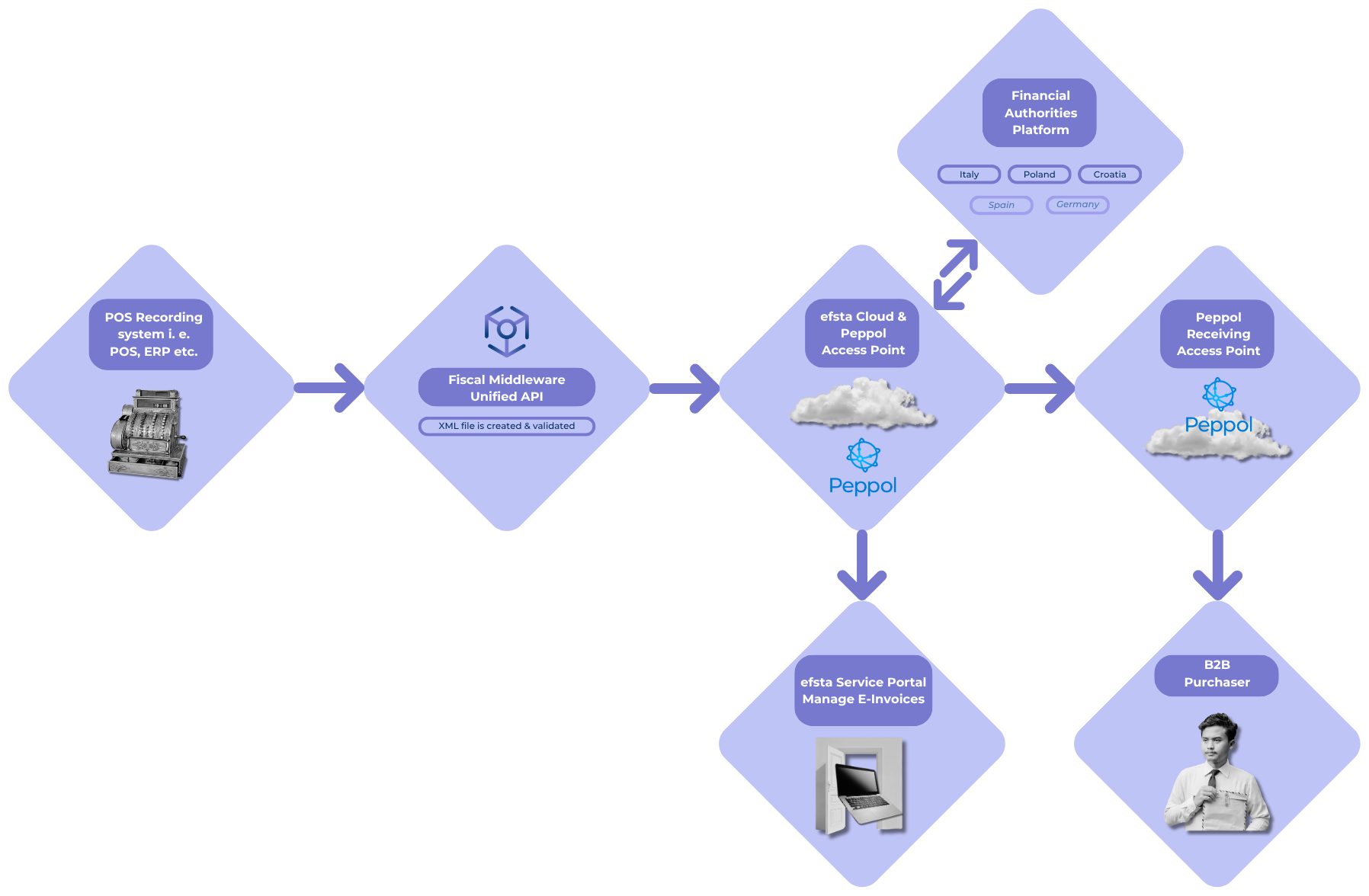
efsta helps companies comply with country-specific e-invoicing requirements. The solution currently covers Germany, Italy, Poland, and Belgium, among others. Additional countries will be added gradually in accordance with local regulatory requirements.

Starting in September 2026, France will introduce mandatory e-invoicing (B2B) and e-reporting (B2C/international B2B).
efsta covers both through a single integration: The Fiscal Middleware (EFR), in partnership with Iopole as an approved “Plateforme Agréée,” handles e-invoicing, e-reporting, and digital merchant onboarding. Existing partners can activate the solution directly on their existing integration.
As of January 1, 2026, electronic invoicing is mandatory for all B2B transactions. Implementation is based on the Peppol BIS 3.0 standard and enables structured, automated processing of e-invoices.
efsta is a certified Peppol Access Point Provider and is fully prepared to meet the requirements. Companies can connect their systems directly to the Peppol network, send e-invoices in compliance with regulations, and benefit from scalable, audit-proof operations.
.png)

The use of e-invoices has been mandatory since January 1, 2025. Businesses must be able to receive and process e-invoices, while transitional provisions apply to the issuance of e-invoices until the end of 2027.
The standard format is XRechnung, which enables structured and automated processing. These requirements are increasingly affecting the B2B sector as well and are driving the standardization of digital invoicing processes.
Electronic invoicing has been mandatory in the B2B sector since 2019. Processing takes place via the SDI system (Sistema di Interscambio) and is based on structured data formats to ensure automated, compliant processing.
efsta supports integration with the SDI system and enables seamless connectivity with existing POS, ERP, and back-office systems.


As of February 1, 2026, electronic invoicing is mandatory in the B2B sector. Processing takes place via the government system KSeF (Krajowy System e-Faktur) and is based on a prescribed XML format.
Companies are required to ensure seamless integration with the KSeF API, validate invoice data, and convert it to the prescribed XML format. Additionally, the invoice status must be tracked in real time, and archiving must be ensured in accordance with Polish regulations.
An e-invoice is an invoice in a structured format that enables automatic electronic processing. It is therefore crucial for businesses that invoice data can be created, transmitted, received, and processed in a machine-readable format.
B2B (Business-to-Business): electronic invoice exchange between businesses.
B2G (Business-to-Government): Invoices to public sector entities—already mandatory in certain EU countries under Directive 2014/55/EU.
B2C (Business-to-Consumer): Invoices to private individuals—there is currently no general EU-wide e-invoicing requirement for B2C.
Current legal requirements primarily concern B2B and B2G. The efsta e-invoicing solution covers both.
An e-invoicing software solution that can generate, validate, transmit, and send structured invoice data is suitable. Especially for international companies, the software should support country-specific requirements, various formats, and different transmission methods. efsta E-Invoicing is part of the Fiscal Middleware and is not limited to a single document format or a specific transmission mechanism.
Yes. efsta E-Invoicing enables the creation of structured e-invoices based on the transmitted transaction and customer data. The e-invoice is validated, converted into the relevant country-specific format, and then processed via the appropriate transmission channel.
Yes. The efsta e-invoicing solution processes B2B and B2G invoice formats on the same platform. Invoices are created, validated, and then sent via the appropriate channel for each country—for example, via SDI, KSeF, or Peppol.
An enterprise e-invoice sending platform creates, validates, and sends electronic invoices to trading partners, government agencies, and e-invoicing networks. It supports multiple formats and country-specific requirements and can be integrated with existing PMS, ERP, and POS systems. With the efsta e-invoicing solution, invoices are sent via a single interface connected to national and international platforms.
An enterprise e-invoice receiving software handles the receipt, validation, and processing of incoming electronic invoices. Documents are automatically verified and forwarded to your PMS, ERP, and POS systems.
E-invoicing network software (also known as an e-invoicing delivery platform) becomes necessary when e-invoices need to reach different recipients, networks, or government systems—such as SDI, KSeF, and Peppol simultaneously. It routes, validates, and delivers invoices via standardized networks and protocols like Peppol, helping to ensure that each country’s regulatory requirements are met. The efsta e-invoicing solution connects companies to established e-invoicing networks via the efsta Cloud and its Peppol Access Point, and consolidates these delivery channels through a single integration platform. Network connectivity can also be combined with local fiscalization requirements in each country, so that both are covered by the same middleware.
Multi-format and multi-country support, enabling invoices to be issued and received in the format required by each market—without the need for separate tools for each country.
Peppol compliance and transparent, traceable processing for regulatory reporting.
Standardized B2B order and invoice exchange via recognized messaging networks instead of proprietary point-to-point connections.
The efsta e-invoicing solution and the Peppol Access Point are designed to meet these criteria and combine format coverage, network connectivity, and country-specific compliance in a single platform.
That depends on the specific country and its regulatory requirements. In Germany, XRechnung plays a central role; in Italy, B2B e-invoicing is handled through the SDI system; in Poland, through KSeF; and in Belgium, through Peppol.
efsta performs formal checks and validations. If an e-invoice is invalid, the transaction may be rejected and an error code will be returned. In the event of delivery or validation errors, an email notification may be sent with instructions on how to correct the issue and resend the invoice.
Yes. Monitoring can be performed via the efstaPortal or directly in the Fiscal Middleware. In the efstaPortal, e-invoices can be viewed, filtered by date or status, and error details can be reviewed. This provides businesses with transparency regarding whether an e-invoice has been successfully processed or whether action is required.
Yes. efsta supports the technical integration of B2B e-invoicing into existing POS, ERP, and PMS systems—from API integration to country-specific configuration. Technical details are available in the efstaDocs, and specific questions can be addressed during a personal consultation.
The efsta e-invoicing solution is not sold as a standalone product—it is integrated into the efsta Fiscal Middleware and is used in conjunction with your existing POS, ERP, or PMS system. Interested companies can request a consultation to clarify the scope, country coverage, and integration effort required for their specific use case. A standalone e-invoicing solution for customers who wish to use only our e-invoicing solution without fiscalization is currently under development.